On this day last year:
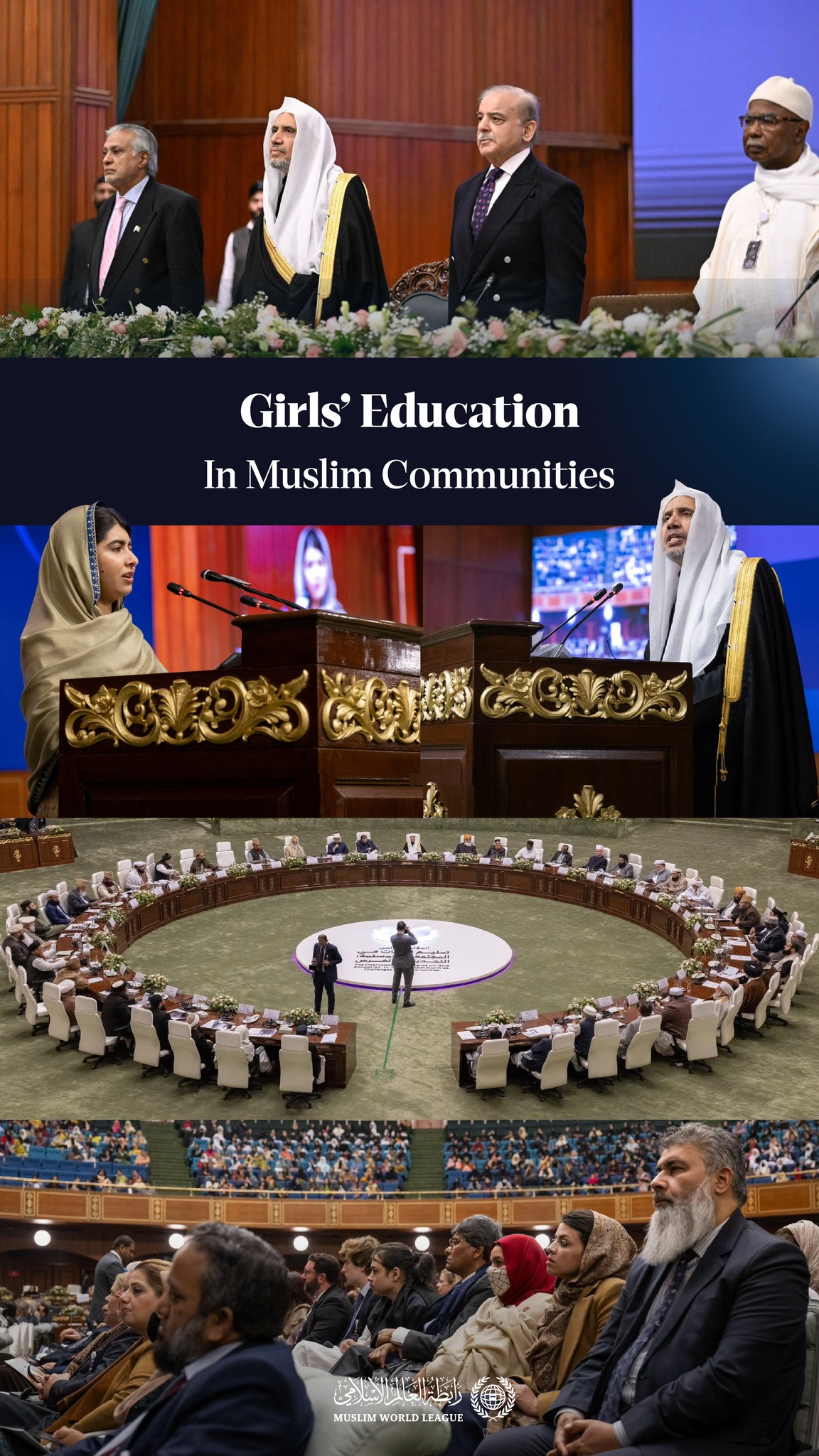
The Islamabad Declaration on Girls’ Education in Muslim Communities was issued, supported by more than twenty (20) international agreements and commitments.
This took place under the patronage and in the presence of the Prime Minister of Pakistan, His Excellency Mr. Shehbaz Sharif;
With the attendance of the global icon and pioneer of girls’ education, Nobel Peace Prize laureate Ms. Malala Yousafzai;
And His Excellency the Secretary-General of the Organization of Islamic Cooperation, Mr. Hissein Brahim Taha, and the Union of News Agencies of the OIC Member States (UNA);
As well as the presence and participation of a number of ministers of education and higher education;
Along with several international governmental and non-governmental organizations;
And with the attendance of the League of Islamic Universities and a number of universities in the Islamic world, both public and private;
His Excellency Sheikh Dr. Mohammed bin Abdulkarim Al-Issa, Secretary-General of the Muslim world league and Chairman of the Organization of Muslim Scholars, together with His Excellency the Prime Minister of Pakistan, launched the initiative “Girls’ Education in Muslim Communities.”
The decisive and influential factor in providing a definitive Islamic ruling on this issue—which had remained unresolved for years in the religious perception of some—was the presence of a number of senior scholars from across the Islamic world, alongside the Islamic Fiqh Council of the Muslim World League and the International Islamic Fiqh Academy of the Organisation of Islamic Cooperation. Together, they issued—by consensus—a final and authoritative ruling on this matter, addressing all its aspects and detailed debates for the first time, based on definitive Islamic legal evidence.
The initiative aims to enhance awareness within Muslim communities of girls’ right to education, without limitation on level or field of study, and to confront erroneous interpretations and obstructive customs that deprive millions of girls of this fundamental right, both religiously and humanly.
The initiative, and the agreements signed under its framework, are also grounded in activating the principles of the #CharterOfMakkah, which affirmed women’s right to legitimate empowerment—foremost among these rights being the right to education.